GC Tooth Mousse or MI Paste Plus – which remineralizing paste to choose?
GC Tooth MousseandGC MI Paste Plusare two specialized preparations for topical application on teeth that have been associated for years with enamel remineralization, reducing sensitivity, and protection against the effects of demineralization. Both products come from the GC brand and are based onRECALDENT™ CPP-ACPtechnology, which is a complex of casein phosphopeptide and amorphous calcium phosphate. Simply put: their task is to deliver bioavailable calcium and phosphates to the enamel – ingredients that are naturally needed to maintain a strong, resistant tooth surface.
The most important difference between them is very specific:GC Tooth Mousse does not contain fluoride, whileGC MI Paste Plus additionally contains fluoride at a concentration of 900 ppm. It is this element that most often determines the choice of product. If you are looking for a fluoride-free remineralizing preparation, GC Tooth Mousse will be chosen more often. However, if you want stronger anti-cavity support and the combination of CPP-ACP with fluoride, MI Paste Plus may be more suitable.
In this guide, you will find a detailed comparison ofGC Tooth Mousse vs MI Paste Plus, a description of how RECALDENT™ technology works, indications for use, contraindications, available flavors, practical selection scenarios, and expert advice. The article has been prepared to help both people buying the preparation for the first time and those who have already used "liquid enamel" but do not know which version to choose for sensitivity, orthodontic braces, white spots, teeth whitening, or high risk of tooth decay.
Why is the topic of enamel remineralization so important?
Enamel is the hardest tissue in the human body, but it is not indestructible. Every day, the surface of the teeth is exposed to acids, bacteria, sugars, carbonated drinks, coffee, fruit juices, energy drinks, reflux, and overly aggressive brushing. As a result, a gradual loss of minerals from the enamel can occur. This process is calleddemineralization.
Demineralization often starts innocently. At first, the patient may not feel any pain. Over time, however, symptoms appear that are hard to ignore: sensitivity to cold, reaction to sweet or sour products, dull enamel, white spots near the gums, discoloration, and at a later stage, greater susceptibility to tooth decay. People wearing orthodontic braces, patients after whitening, people with dry mouth, children and adolescents, people who frequently drink acidic beverages, and patients with a diet rich in sugars are particularly vulnerable.
That is why prevention, which is not limited to just brushing, is becoming increasingly important. Modern oral hygiene is a combination of several elements: toothpaste tailored to needs, cleaning interdental spaces, regular visits to the dentist, diet control, and the use of preparations supporting enamel remineralization. This last group includesGC Tooth MousseandGC MI Paste Plus.
What does enamel demineralization mean?
Enamel demineralizationis the process of losing mineral components from the tooth surface. The most important of these are calcium and phosphates. When the pH in the oral cavity drops, the environment becomes acidic. In such a situation, the enamel begins to release minerals to neutralize the acids. If this process is repeated frequently and the breaks between meals are short, saliva does not have enough time to naturally rebuild the mineral balance.
The most common causes of demineralization include:
- frequent consumption of sugar, sweets, and snacks between meals,
- drinking carbonated, energy, isotonic drinks, and fruit juices,
- frequent eating of sour fruits, vinegar, pickles, and fermented products,
- gastroesophageal reflux, which exposes the enamel to contact with stomach acids,
- dry mouth and reduced amount of saliva,
- wearing orthodontic braces and more difficult cleaning around brackets,
- improper tooth brushing, especially too much brush pressure,
- use of highly abrasive whitening toothpastes,
- lack of regular cleaning of interdental spaces,
- too frequent teeth whitening or lack of remineralization after the procedure.
The biggest problem is that demineralization can develop for a long time without pain. The patient only notices the effect: white spots, sensitivity, a rough enamel surface, or faster cavity formation. Therefore, remineralizing preparations make the most sense when they are used early enough – before micro-damage turns into cavities requiring dental treatment.
What is enamel remineralization?
Enamel remineralizationis the process of re-supplying minerals to the weakened tooth surface. In natural conditions, it is supported by saliva, which contains calcium and phosphate ions. The problem arises when the enamel is too often exposed to acids or when the amount of saliva is insufficient. In such a situation, natural protective mechanisms may not keep up with daily demineralization.
Preparations such as GC Tooth Mousse and MI Paste Plus are designed to support this process by delivering mineral components directly to the tooth surface. However, this should not be understood as "enamel regrowth" in a biological sense. Enamel does not regenerate like skin. Remineralization rather means strengthening and mineral reconstruction of micro-damage and increasing the resistance of the tooth surface to acids.
In practice, remineralization can support:
- reduction of tooth sensitivity,
- limiting the development of white demineralization spots,
- strengthening enamel after whitening,
- enamel protection during orthodontic treatment,
- prevention of early tooth decay,
- improving comfort for people with enamel erosion,
- supporting tooth protection in patients with dry mouth.
RECALDENT™ CPP-ACP – technology that combines GC Tooth Mousse and MI Paste Plus
The most important ingredient of both preparations isRECALDENT™ CPP-ACP. The abbreviation CPP-ACP stands forCasein Phosphopeptide-Amorphous Calcium Phosphate, which is casein phosphopeptide and amorphous calcium phosphate. This complex is derived from milk casein and was developed to stabilize calcium and phosphates and facilitate their delivery to the enamel surface.
It is this technology that makes GC Tooth Mousse and MI Paste Plus more than just ordinary toothpastes. They are topical creams intended to remain on the enamel surface for several minutes. This gives the active ingredients time to bind with the biofilm, plaque, acquired pellicle, and tooth surface.
In simple terms, RECALDENT™ acts as a carrier for calcium and phosphates. Instead of delivering minerals randomly, it helps keep them close to the tooth surface. This is particularly important when the enamel is weakened and the oral cavity is frequently exposed to an acidic environment.
GC Tooth Mousse – what is it?
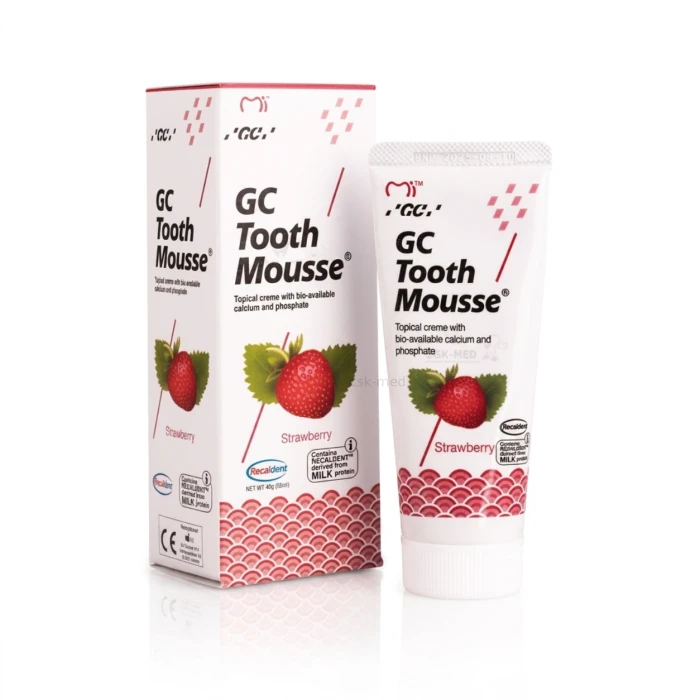
GC Tooth Mousseis a remineralizing cream for topical application on teeth. It is very often colloquially referred to as "liquid enamel," although it would be more precise to say that it is a preparation supporting enamel remineralization. The product contains the RECALDENT™ CPP-ACP complex, which is a source of bioavailable calcium and phosphates.
GC Tooth Mousse is not used for classic brushing like regular toothpaste. It is most commonly used after brushing teeth – a small amount of the cream is spread over the enamel surface and left for several minutes. After application, you should not rinse your mouth with water immediately, as this shortens the contact of active ingredients with the teeth.
GC Tooth Mousse can be a good choice for people who:
- are looking for a remineralizing preparation without fluoride,
- have tooth sensitivity,
- are after teeth whitening,
- have noticed white spots on the enamel,
- have weakened enamel after a diet rich in acids,
- wear orthodontic braces,
- have dry mouth,
- want to support daily enamel protection.
In the CSK-MED store, you can find products from this group here:GC Tooth Mousse – remineralizing pastes.
-
Price $21.81
-
Price $23.60
-
Price $23.60
-
Price $23.60
-
Price $23.60

GC MI Paste Plus – what is it?
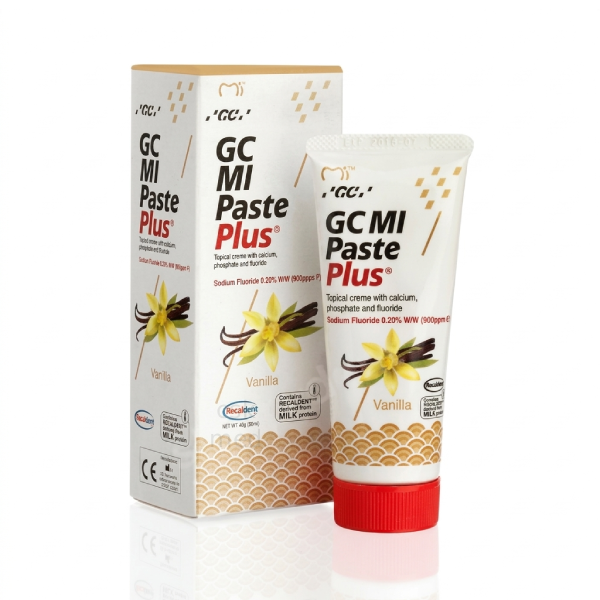
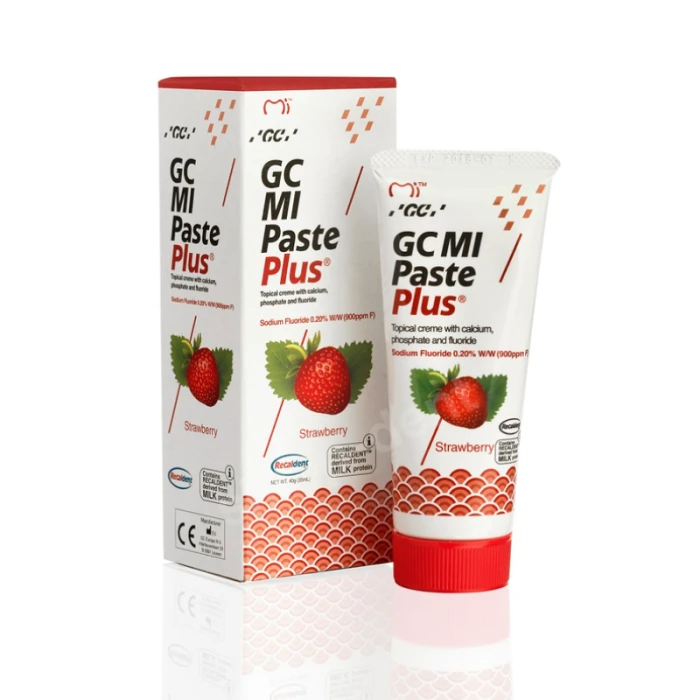
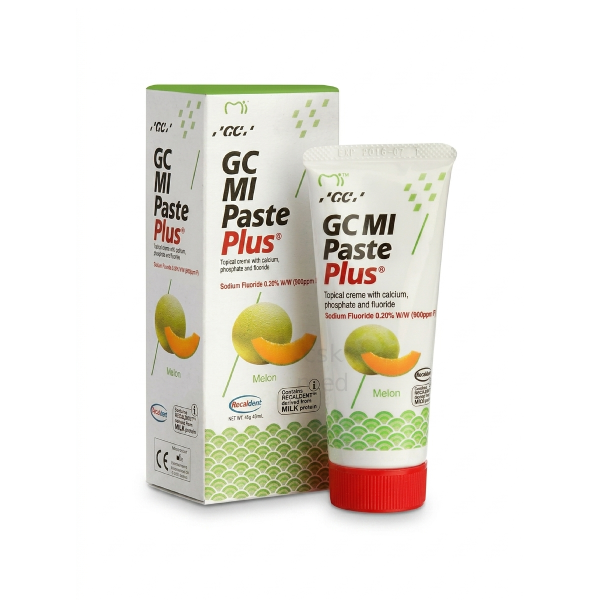
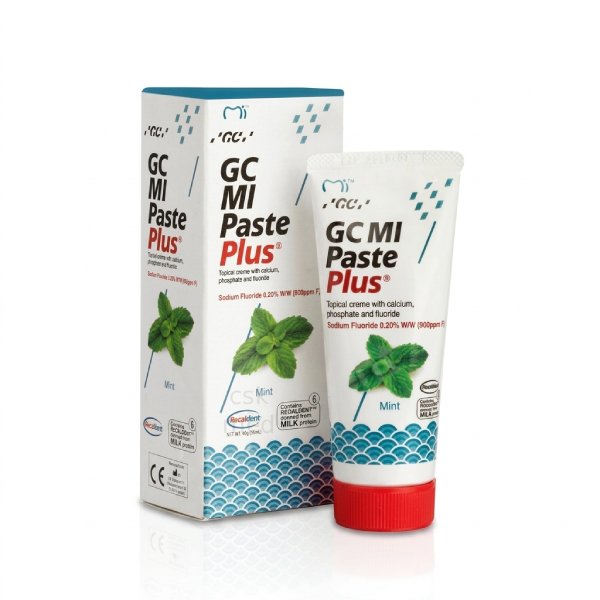
GC MI Paste Plusis a preparation very similar to GC Tooth Mousse, but enriched with fluoride. It contains the RECALDENT™ CPP-ACP complex and fluoride at a concentration of 900 ppm. Thanks to this, it combines the action of calcium, phosphates, and fluoride, which are three very important ingredients for enamel protection.
MI Paste Plus is often chosen when a patient has a higher risk of tooth decay or needs more intensive remineralization support. It can be particularly useful for people after orthodontic treatment, for white spots, after whitening, with frequent demineralization, or when a dentist recommends additional fluoride support.
However, it is worth remembering that the presence of fluoride means that MI Paste Plus will not be the best choice for everyone. People who consciously avoid fluoride usually choose the classic GC Tooth Mousse. On the other hand, people with a high risk of tooth decay can often benefit more from the Plus version, but it is best to consult this with a dentist.
-
Price $26.46
-
Price $26.46
-
Price $26.46
-
Price $26.46
-
Price $26.46
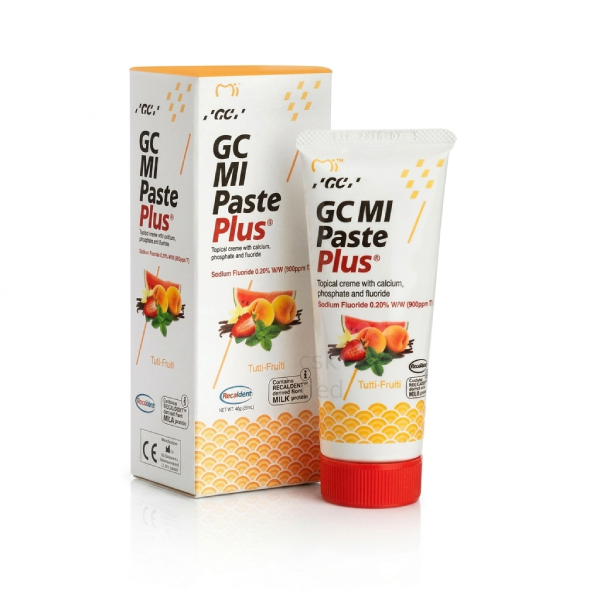
GC Tooth Mousse vs MI Paste Plus – the main difference in one sentence
GC Tooth Mousseis a preparation with RECALDENT™ CPP-ACP without fluoride, whereasGC MI Paste Plusis a preparation with RECALDENT™ CPP-ACP and the addition of 900 ppm fluoride.
This means that both products share a common remineralizing base, but MI Paste Plus provides an additional element of fluoride protection. That is why it is impossible to honestly say that one product is always better than the other. The better one will be the one that suits the specific situation of the patient.
Expert Advice: how a dentist might approach the choice?
Dental advice:if the patient mainly has sensitivity, weakened enamel after whitening, or wants remineralization without fluoride, it is usually worth considering GC Tooth Mousse. However, if there is a high risk of tooth decay, white spots after braces, frequent cavities, or a need for additional fluoridation, MI Paste Plus may be more justified. The final choice should be tailored to age, hygiene, diet, amount of saliva, and the current state of the enamel.
Such advice does not replace a visit to the dentist, but it well illustrates the practical difference between the products. In dentistry, it's not about choosing the "strongest" preparation for everyone. It's about matching the product to a specific problem: sensitivity, demineralization, orthodontic braces, whitening, early decay, or prevention.
GC Tooth Mousse for tooth sensitivity – why is it so often recommended?
Tooth sensitivityis one of the most common dental problems in adults. It manifests as a short, sharp pain occurring during contact with cold, hot, sweet, or sour products. For many people, daily activities such as drinking cold water or brushing teeth begin to be unpleasant.
Most often, sensitivity is associated with:
- weakened enamel,
- acid erosion,
- exposed dentin,
- too aggressive brushing,
- gum recession,
- teeth whitening,
- bruxism,
- frequent consumption of acidic products.
GC Tooth Mousse very often appears in dental recommendations for sensitivity. The preparation does not act like classic "nerve-blocking" toothpastes, but supports the remineralization process and delivers calcium and phosphates to the tooth surfaces.
As a result, it can help:
- strengthen weakened enamel,
- reduce tooth reaction to cold and heat,
- improve comfort during eating and drinking,
- limit discomfort after whitening.
Many people notice improvement after just a few days of regular use, although the best results usually appear after longer use of the preparation.
GC Tooth Mousse after teeth whitening
After whitening, enamel very often becomes more sensitive. This is a normal reaction resulting from temporary dehydration of the enamel and increased permeability of the tooth surface. In practice, patients most often complain of:
- pain with cold drinks,
- a "pulling" sensation in the teeth,
- reaction to sweet products,
- discomfort when breathing in cold air.
That is why many dentists recommend remineralizing preparations after whitening. GC Tooth Mousse can support the mineral reconstruction of enamel and improve comfort after the procedure.
The most commonly recommended regimen looks as follows:
- brush your teeth with a gentle toothpaste,
- apply a thin layer of GC Tooth Mousse,
- leave the preparation for several minutes,
- do not rinse your mouth immediately with water,
- avoid eating and drinking for about 30 minutes.
After whitening, many people choose vanilla or melon flavor, as they are gentler and less irritating to sensitive enamel.
GC Tooth Mousse with orthodontic braces
Orthodontic patients belong to a group particularly vulnerable to enamel demineralization. Brackets make thorough cleaning of teeth difficult, causing plaque to accumulate more easily around the elements of the braces.
One of the most common problems after removing braces are characteristic white spots. These are places of enamel demineralization that occurred due to the action of bacteria and acids.
Preparations such as GC Tooth Mousse and MI Paste Plus are very often used precisely as enamel protection support during orthodontic treatment.
The most commonly recommended actions are:
- thorough brushing after every meal,
- using orthodontic brushes,
- using a dental irrigator,
- regular cleaning of interdental spaces,
- evening application of a remineralizing preparation.
In practice, many orthodontists recommend MI Paste Plus for higher risk of tooth decay and Tooth Mousse for patients looking for remineralization without fluoride.
White spots on teeth – does GC Tooth Mousse help?
White spots on enamelare very often the first visible symptom of demineralization. They can appear:
- after orthodontic braces,
- with poor oral hygiene,
- in children and adolescents,
- after frequent consumption of sweet drinks,
- during enamel erosion.
Early demineralization changes are one of the main reasons dentists recommend remineralizing preparations. Regular use can support the mineral reconstruction of the enamel and limit further deepening of the changes.
However, it is worth remembering that very advanced white spots may require additional dental treatment.
GC Tooth Mousse for enamel erosion
Enamel erosion is a problem that has been appearing more and more frequently in recent years. This is primarily influenced by lifestyle and a diet rich in acidic products.
The most common causes of enamel erosion:
- energy drinks,
- cola and carbonated drinks,
- citrus fruits and fruit juices,
- vinegar and fermented products,
- gastroesophageal reflux,
- frequent snacking.
People with enamel erosion often notice:
- greater transparency of tooth edges,
- dull enamel,
- sensitivity,
- yellowish tooth color,
- faster wear of tooth surfaces.
Remineralizing preparations can support enamel protection against further acid action and improve patient comfort.
GC Tooth Mousse and dry mouth
Saliva plays a very important protective role. It neutralizes acids, supports natural remineralization, and helps clean the oral cavity.
When the amount of saliva is reduced, the risk of dental problems increases significantly.
Dry mouth can be associated with:
- stress,
- medications,
- dehydration,
- systemic diseases,
- mouth breathing,
- age.
Patients with dry mouth often have increased susceptibility to tooth decay, sensitivity, and enamel erosion. In such situations, remineralizing preparations can be a helpful element of daily prevention.
GC Tooth Mousse for children – can it be used?
This is one of the most frequently searched questions on Google. Many parents look for a preparation to support enamel protection in children, especially with white spots, sensitivity, or after orthodontic treatment.
GC Tooth Mousse is also used for younger patients, but it is always worth consulting with a pediatric dentist.
It is particularly important to pay attention to:
- the child's age,
- the risk of swallowing the preparation,
- the presence of allergies to milk proteins,
- the current state of the enamel.
Children most often choose the following flavors:
- Strawberry,
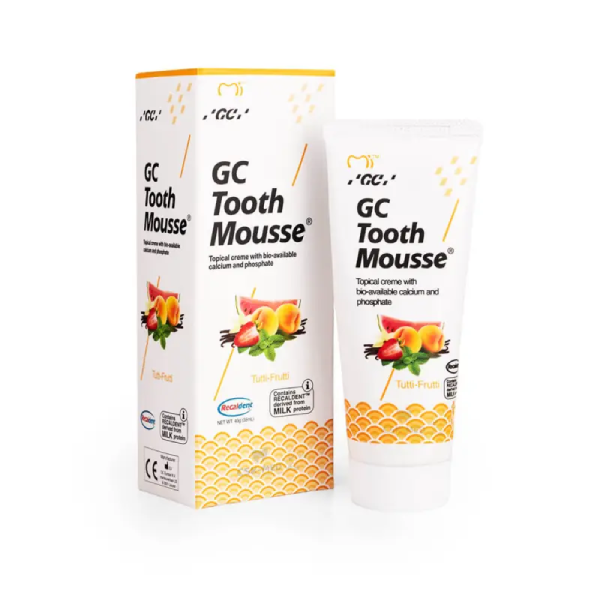
- Tutti Frutti,
- Melon.
GC Tooth Mousse during pregnancy
Pregnant women often notice a deterioration in their oral health. Hormonal changes, frequent snacking, nausea, and an acidic environment in the oral cavity all have an impact.
Many women then complain of:
- increased sensitivity,
- gum bleeding,
- greater susceptibility to tooth decay,
- a feeling of weakened enamel.
Remineralizing preparations are sometimes also used by pregnant women, but it is worth discussing this with a dentist or attending physician each time.
GC Tooth Mousse and gastric reflux
Patients with reflux often do not realize how much stomach acids affect the enamel. Regular contact with acids can lead to rapid erosion of tooth surfaces.
Dental symptoms of reflux may include:
- sensitivity,
- enamel erosion,
- dull teeth,
- greater susceptibility to wear,
- burning sensation in the mouth.
In such situations, remineralizing preparations can support the protection of the enamel surface against further acid action.
GC Tooth Mousse and bruxism
Bruxism, or teeth grinding, leads to mechanical wear of the enamel. Patients very often report:
- sensitivity,
- worn tooth edges,
- micro-cracks in the enamel,
- pain in the chewing muscles,
- a feeling of overloaded teeth.
Although remineralizing preparations do not solve the problem of grinding itself, they can support the protection of weakened enamel and improve patient comfort.
Can GC Tooth Mousse be used daily?
Yes – many dentists recommend daily use of the preparation, especially for chronic sensitivity, orthodontic braces, or increased risk of demineralization.
Most often, the preparation is used:
- in the evening after brushing,
- once a day,
- temporarily after whitening,
- in several-week treatments,
- long-term for sensitivity.
The best results are usually given by regularity and combining the preparation with proper oral hygiene.
What mistakes to avoid during use?
Many people make mistakes that reduce the effectiveness of the preparation.
The most common ones:
- immediate rinsing of the mouth with water,
- eating right after application,
- using too little of the preparation,
- irregular use,
- treating the preparation like a regular toothpaste.
GC Tooth Mousse and MI Paste Plus work best when they remain on the tooth surface for several minutes.
GC Tooth Mousse vs MI Paste Plus – which solution to choose in a specific situation?
One of the most frequently searched questions on Google is:“GC Tooth Mousse or MI Paste Plus?”. In practice, the answer depends on the problem the patient is struggling with. There is no one ideal preparation for everyone. A person after teeth whitening will have completely different needs than an orthodontic patient, and yet another person with high caries risk or reflux.
Below you will find a practical comparison of the most common scenarios.
| Situation | Better Choice | Why? |
| Sensitivity after whitening | GC Tooth Mousse | Gentle remineralization without additional fluoride |
| High caries risk | MI Paste Plus | CPP-ACP + 900 ppm fluoride |
| White spots after braces | MI Paste Plus | Stronger remineralization support |
| People avoiding fluoride | GC Tooth Mousse | No fluoride |
| Enamel erosion | GC Tooth Mousse | Support for enamel mineral reconstruction |
| Dry mouth | GC Tooth Mousse | Daily protection of weakened enamel |
| Orthodontic treatment | MI Paste Plus | Additional anti-caries protection |
| Daily prevention | Both preparations | Choice depends on the patient's needs |
GC Tooth Mousse – available flavor variants
One of the greatest advantages of GC products is the wide selection of flavors. Many people use the preparation regularly precisely because it does not resemble classic "medical" dental products.
Available GC Tooth Mousse flavor variants:
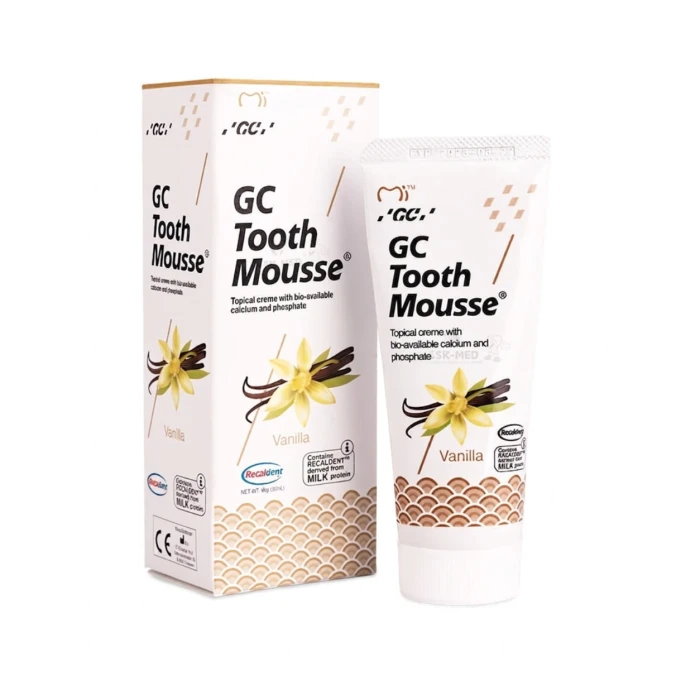
- Vanilla,
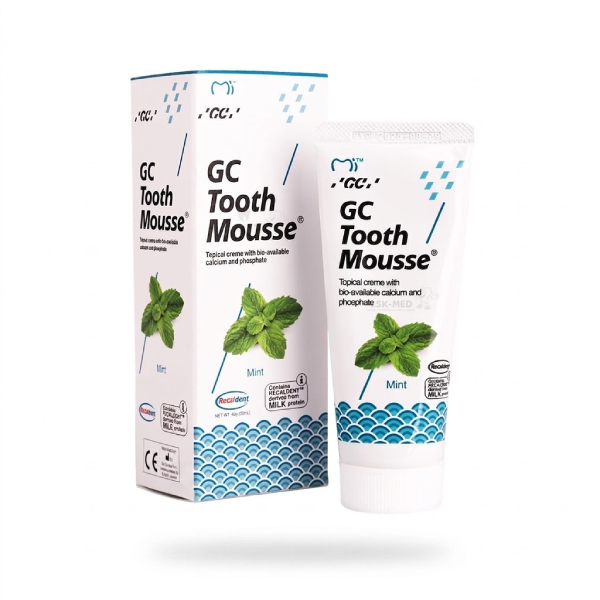
- Mint,
- Melon,
- Strawberry,
- Tutti Frutti.
Check the available variants here:GC Tooth Mousse – remineralizing pastes.
Which GC Tooth Mousse flavor to choose?
Although flavor does not affect the effectiveness of remineralization, it is very important for the regular use of the preparation.
Most commonly chosen variants:
- Vanilla– very popular after whitening and for sensitivity,
- Mint– chosen by people who prefer a classic feeling of freshness,
- Melon– a delicate taste, often chosen by children and people with flavor sensitivity,
- Strawberry– one of the most popular flavors among younger users,
- Tutti Frutti– a fruity variant particularly liked by children.
GC Tooth Mousse after scaling and sandblasting
Many people notice sensitivity after professional tooth cleaning. After scaling and sandblasting, the enamel surface can be more reactive to cold and acidic products.
GC Tooth Mousse is sometimes used after dental hygiene to:
- reduce sensitivity,
- support enamel remineralization,
- improve patient comfort,
- protect weakened spots on the tooth surface.
GC Tooth Mousse and diet – what to avoid?
Even the best remineralizing preparation will not be effective if the enamel is exposed to the aggressive action of acids every day.
Products that particularly burden the enamel:
- cola and carbonated drinks,
- energy drinks,
- isotonic drinks,
- citrus fruits and fruit juices,
- vinegar and fermented products,
- sweets consumed between meals.
It is worth remembering that not only the amount of sugar but also the frequency of contact with acids is of great importance.
The biggest mistakes destroying enamel
Many patients unconsciously weaken their enamel every day. The most common mistakes are:
- brushing teeth immediately after drinking cola or juice,
- using very hard toothbrushes,
- applying too much pressure with the brush,
- frequent use of aggressive whitening toothpastes,
- lack of flossing and cleaning of interdental spaces,
- continuous snacking throughout the day.
That is why modern dentistry is increasingly focusing not only on treating cavities but also on prevention and enamel protection.
GC Tooth Mousse and whitening toothpastes
Many people use highly abrasive whitening toothpastes for many months. The problem is that some of them can lead to enamel weakening and sensitivity.
Symptoms of too aggressive whitening toothpaste:
- pain with cold drinks,
- dull enamel,
- greater transparency of tooth edges,
- a feeling of "thin enamel",
- discomfort during brushing.
In such situations, many people reach for remineralizing preparations as support for the mineral reconstruction of the enamel.
Can GC Tooth Mousse replace toothpaste?
No. This is a very common misunderstanding.
GC Tooth Mousse and MI Paste Plus do not replace classic toothpaste for daily brushing. They are supplementary preparations that are most often used after brushing.
Daily hygiene should still include:
- brushing teeth at least 2 times a day,
- cleaning interdental spaces,
- regular toothbrush replacement,
- diet control,
- visits to the dentist.
GC Tooth Mousse and flossing and interdental spaces
Many people focus exclusively on brushing, forgetting about interdental spaces. Meanwhile, that is where tooth decay very often develops.
The best preventive results are given by the combination of:
- tooth brushing,
- cleaning interdental spaces,
- using remineralizing preparations.
With orthodontic braces or larger spaces, it is also worth considering interdental brushes and a dental irrigator.
GC Tooth Mousse – how long to use?
Usage time depends on the patient's problem.
The most common scenarios:
- after whitening – a few days or weeks,
- for sensitivity – until symptoms disappear,
- with orthodontic braces – throughout the treatment period,
- for enamel erosion – long-term,
- preventatively – regularly in the evening.
GC Tooth Mousse – user reviews
The most frequently repeated reviews concern:
- reduction of sensitivity,
- pleasant flavors,
- feeling of smoother teeth,
- greater comfort after whitening,
- improvement in enamel condition.
Many people also emphasize that regular use helps limit discomfort associated with cold drinks.
GC Tooth Mousse – for whom will it be the best choice?
GC Tooth Mousse is most often chosen by people:
- with tooth sensitivity,
- after whitening,
- with enamel erosion,
- avoiding fluoride,
- with dry mouth,
- after scaling and sandblasting,
- with weakened enamel.
MI Paste Plus – for whom could it be better?
MI Paste Plus is often chosen by people:
- with high caries risk,
- after orthodontic treatment,
- with white demineralization spots,
- needing additional fluoridation,
- having frequent carious cavities.
Where to buy original GC Tooth Mousse?
Remineralizing preparations should be purchased only from reliable dental stores offering original products from authorized distributors.
Check out:
- GC Tooth Mousse – remineralizing pastes
- GC Tooth Mousse Vanilla
- GC Tooth Mousse Strawberry
- CSK-MED – dental store
Expert advice – what do patients often not know?
Dental advice:many patients focus exclusively on choosing the "strongest" paste, forgetting the basics. Meanwhile, the biggest impact on enamel condition is hygiene regularity, limiting frequent snacking, and cleaning interdental spaces. Remineralizing preparations work best as part of an entire enamel protection plan, and not as the only solution to the problem.
This is very important, because even the best preparation will not work effectively if the enamel is destroyed every day by a diet rich in sugars and acids.
GC Tooth Mousse or MI Paste Plus – summary of the most important differences
BothGC Tooth MousseandGC MI Paste Plusare among the most popular preparations supporting enamel remineralization. Both products are based onRECALDENT™ CPP-ACPtechnology, a complex delivering calcium and phosphates to the tooth surface.
The biggest difference between them is the presence of fluoride in MI Paste Plus. It is this element that most often decides the choice of a specific preparation.
In simple terms:
- GC Tooth Mousse– remineralization without fluoride,
- GC MI Paste Plus– remineralization + 900 ppm fluoride.
When is it worth choosing GC Tooth Mousse?
GC Tooth Mousse is very often chosen by people who:
- have tooth sensitivity,
- are after whitening,
- have weakened enamel,
- struggle with enamel erosion,
- are looking for remineralization without fluoride,
- have dry mouth,
- feel discomfort after scaling and sandblasting.
The preparation is also often recommended for people drinking a lot of coffee, energy drinks, and patients with gastroesophageal reflux.
When will MI Paste Plus work better?
MI Paste Plus may be a better choice for higher caries risk and more advanced enamel demineralization.
It is most often chosen by people:
- after orthodontic treatment,
- with white demineralization spots,
- with high caries risk,
- needing additional fluoride protection,
- having frequent problems with new cavities.
Why have remineralizing preparations gained such popularity?
A dozen or so years ago, dentistry mainly focused on treating the effects of problems. Today, more and more emphasis is placed on prevention and enamel protection before large cavities appear.
This is why preparations such as GC Tooth Mousse and MI Paste Plus are so often recommended:
- after whitening,
- after hygiene procedure,
- during orthodontic treatment,
- for sensitivity,
- for enamel erosion,
- in patients with a diet rich in acids.
Is using GC Tooth Mousse alone enough?
No. This is a very important issue that many patients forget.
Even the best remineralizing preparation will not be effective if the enamel is weakened every day by:
- constant snacking,
- energy drinks,
- acidic drinks,
- lack of interdental space hygiene,
- highly abrasive whitening toothpastes,
- too aggressive brushing.
The best results come from combining:
- regular brushing,
- cleaning interdental spaces,
- diet control,
- regular visits to the dentist,
- use of remineralizing preparations.
Most common mistakes made by patients
In dental practice, the same mistakes are very often repeated:
- brushing teeth immediately after drinking cola or juice,
- drinking energy drinks over many hours,
- skipping interdental spaces,
- using too hard toothbrushes,
- irregular hygiene,
- using the preparation only occasionally.
It is regularity that matters most in enamel protection.
GC Tooth Mousse – most popular applications
- tooth sensitivity,
- enamel remineralization,
- protection after whitening,
- support after dental hygiene,
- enamel protection with orthodontic braces,
- white demineralization spots,
- enamel erosion,
- dry mouth.
GC Tooth Mousse – available flavors
The preparation is available in several flavor variants:
- Vanilla,
- Mint,
- Melon,
- Strawberry,
- Tutti Frutti.
Most commonly chosen flavors:
- vanilla – after whitening and for sensitivity,
- strawberry – for children and younger users,
- mint – for people preferring a classic feeling of freshness.
Where to buy original GC Tooth Mousse?
Remineralizing preparations should be purchased only from reliable dental stores offering original products from authorized distributors.
Check available variants:
- GC Tooth Mousse – remineralizing pastes
- GC Tooth Mousse Vanilla
- GC Tooth Mousse Strawberry
- CSK-MED – dental store
Dentist expert advice
Dental advice:remineralizing preparations work best as part of daily prevention, rather than the only solution to a problem. The greatest impact on enamel condition is regular hygiene, limiting frequent contact with acids, and rapid reaction to the first symptoms of sensitivity and demineralization.
Sources and studies
- GC Dental Europe – GC Tooth Mousse
- GC Dental Europe – MI Paste Plus
- Official GC Tooth Mousse website
- PubMed – studies on CPP-ACP
- GC Tooth Mousse – CSK-MED
- Zakrzewski Dental – comparison of Tooth Mousse and MI Paste Plus
Key information at a glance
- GC Tooth Mousse does not contain fluoride,
- MI Paste Plus contains 900 ppm fluoride,
- both preparations are based on RECALDENT™ CPP-ACP,
- products support enamel remineralization,
- they are often used for sensitivity,
- they can be helpful after whitening and with orthodontic braces,
- they do not replace daily tooth brushing,
- regular use gives the best results.
Final summary
If you are looking for a fluoride-free enamel remineralization support preparation, a very good choice could beGC Tooth Mousse. If you want additional anti-caries protection and a combination of calcium, phosphates, and fluoride, it is worth consideringMI Paste Plus.
Both preparations have been among the most frequently recommended remineralizing products used in modern dental prevention for years.
 Log in with Facebook
 Log in with Google